

— Let’s add gamification! We’ll be like Duolingo, every retention metric skyrockets, viral memes everywhere!
— What about burning developer hours, distracting product focus from core utility and noisy user data? Our investors are not going to like it.
— Wait, gamification is not a cheat code? And investors are actually smart?
— Correct.
To avoid the deadweight, you need to recognize the two scenarios where gamification actually works and be suspicious of everything else.
Products with a natural fit for gamification
Let’s take a look at the essence of any game. Which is:
Challenge → Achievement → Reward
So the best possible foundation for gamification is the activity where users are already involved in challenges that matter to them. All we need to do is to help them to celebrate achievements. Closing rings on the Apple Watch is a perfect example:
The challenge: a high level of physical activity.
The achievement: 10000 steps.
The reward: a notification about closing the ring.
Adding a virtual reward for a real-life challenge makes the everyday grind more tolerable and adds value to the product. It is a clear win.
If your product has no such natural fit for gamification, you might be tempted to stimulate users offering valuable rewards, like free subscriptions or vouchers. It can work too, but forced gamification comes with side effects. Some customers will be annoyed with distractions, others will try to exploit the system and milk rewards. Sure, the activity metrics can jump, but is it really the activity you want?
Personal anecdote: I always find Xbox reward points irritating. Reward for playing every day? Seriously? There is no challenge and no achievement to celebrate. It is just another bothering notification.
I checked whether people are trying to take advantage of the program and of course they are. There is a whole subreddit with 45k users who try to maximize point-earning with approaches like this:
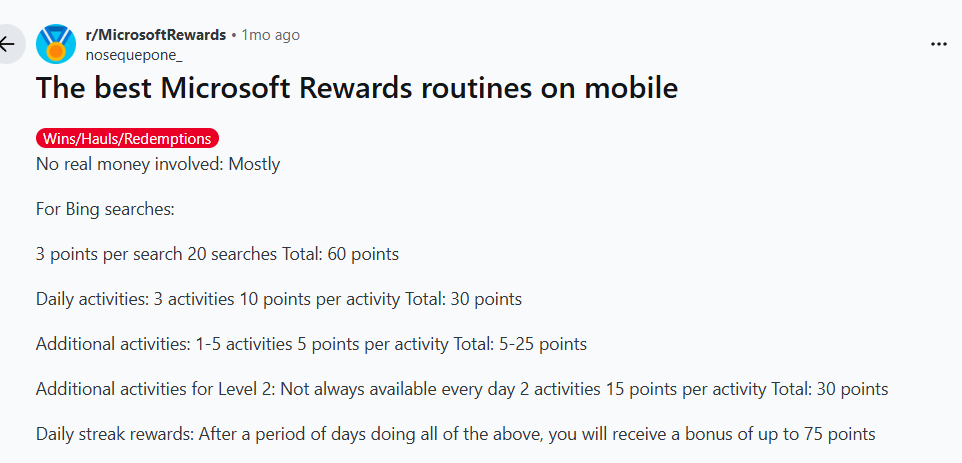
Given the scale of Microsoft’s user base, their reward system can still make sense. If you have a huge audience, even a small increase in users activity can give you a positive ROI despite large upfront costs. That’s economies of scale at work.
What if your product has no inherent challenge and for now you’re only dreaming about the economy of scale? Well, you have one more case when gamification makes sense.
Gamification as a targeted booster of sales
Here is a savvy attempt to implement gamification not for abstract user engagement, but for boosting revenue and margins from Airbaltic:
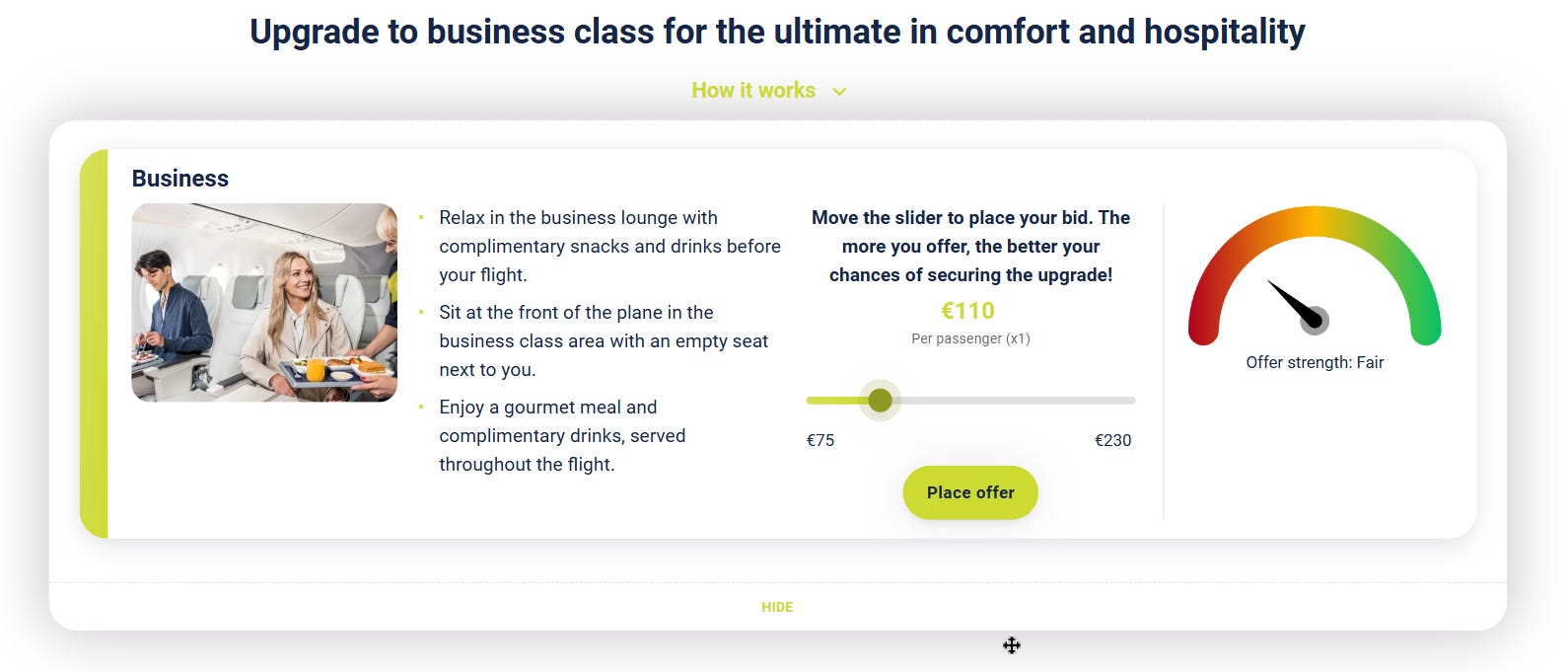
Note, they do not try to make a direct upsell like “Pay additional 100 euro for business class“. They invite you to place an offer, challenging you to guess other people’s offers and promising a relatively cheap upgrade as a reward in case you are right. And don’t forget the sweet feeling of you outsmarting the system if you won with the minimal bet!
I have no stats on how much this mini-game boosted sales, so I cannot declare this case a success. But it has all the traits of good tactical gamification:
low-cost implementation (just one landing page upgrade + a couple of new email templates);
used in a tough part of customer journey where traditional methods likely hit their ceiling;
clear and intrinsically important success metrics (we either make more money or not).
Conclusions
There are two cases when gamification makes sense:
Your users are already playing, just do not know about it: they face challenges and crave recognition. Products related to learning, good habits, competition are a natural fit for gamification.
You have a specific weak point of customer journey and your gamification idea can be quickly and objectively tested.
In other cases gamification means risk of improving metrics for the sake of metrics, not for users and money.
Practical implications
For founders: if your product has no inherent challenge, gamification is roadmap deadweight. Delay its implementation until you have a very good reason to do so (like the economy of scale in case of Microsoft).
For product managers: consider gamification as a local tool to do heavy lifting in parts of product which now have bad metrics. Make sure you can easily measure the effect.
For investors: if early-stage startup leans towards gamification despite its product having no intrinsic challenges and achievements, it is a red flag. Moreover, assessing the startup’s unit economics, you should separate users who pay for core utility and those involved in games. They usually have drastically different LTV.
Not sure your product roadmap is free from forced gamification or other negative ROI features? Schedule a call with me and I will help you weed them out.