

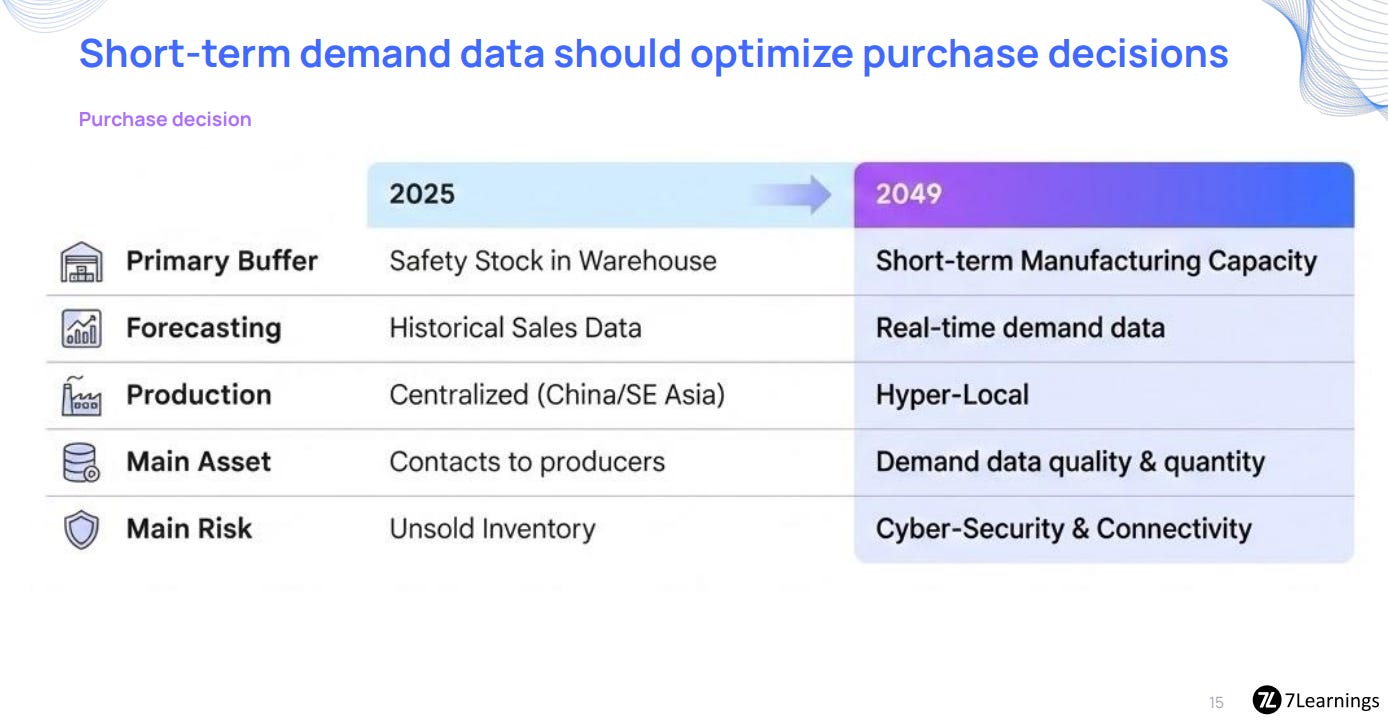
This week I was listening to a speech by Felix Hoffmann “E-commerce 2049: A Post-Website World“. He drew a concise and logical picture of long-term ecommerce trends:
75% of purchases will be done via an AI concierge.
AI will make most of the decisions, customers will give final approval.
To be competitive, retailers should ensure the quality and AI-readability of their product data and also outsource most decisions to AI, optimizing marketing, promotions and pricing together.
Marketing plays a relatively small role because of highly objective AI assistants, which are incentivized to maintain users’ trust and give them the best choice.
My take
I think it is a solid prediction; we certainly have prerequisites for such an ecosystem, so this vision is likely to become an everyday reality. But I don’t think it is the whole picture.
It reminds me of sci-fi novels written 50 years ago. How did their authors imagine working with information in the future? Many of them described a global knowledge database, a convenient digital library which helps to find any information on Earth.
And they were right. Now we have Wikipedia, Google and ChatGPT. But none of them predicted1:
Social media & scammers with $99 courses.
Search Engine Optimization & link bombing.
Ads personalization to the point of paranoia.
The future of ecommerce is also much messier. There are at least three reasons.
First, many users will prefer a slightly biased AI assistant with ads to an absolutely objective and ad-free one, but with $20 monthly subscription. Think about OpenAI’s recent move introducing ads on the free plan.
Second, in many cases there is no one objectively best answer. If a user wants “a t-shirt with a funny print”, how many options can satisfy them completely? Thousands. So an AI agent can suggest a product from the highest bidder without compromising user’s utility.
Third, AGI is still present only in inspired talks of AI lab founders, who need another multi-billion funding round. AI systems are trickable. They rely on the data available. Influence this data → influence AI decision. The more users trust AI, the more tempting it is for businesses to exploit this trust. So they will try and will succeed2.
What businesses should do, then?
Prepare for AI-driven purchases, of course, as Felix suggests (btw, here is his newsletter).
But at the same time invest in branding, SEO and GEO. They are here to stay until human nature changes.
The businesses that will win in 2049 are those who learn to exploit the AI ecosystem, not just scrambling for a tiny profit margin at the bottom of the food chain.
Obviously, I haven’t read all the XX century sci-fi. But I guess the overwhelming majority of books described rather Wikipedia than clickbait and AI slop.
Just like search engines are unable to completely neutralize SEO spam, AI agents will be unable to neutralize this marketing influence. Of course, in 2036 there will be headlines “GEO is dead”, but everyone will know it is just for hype’s sake.